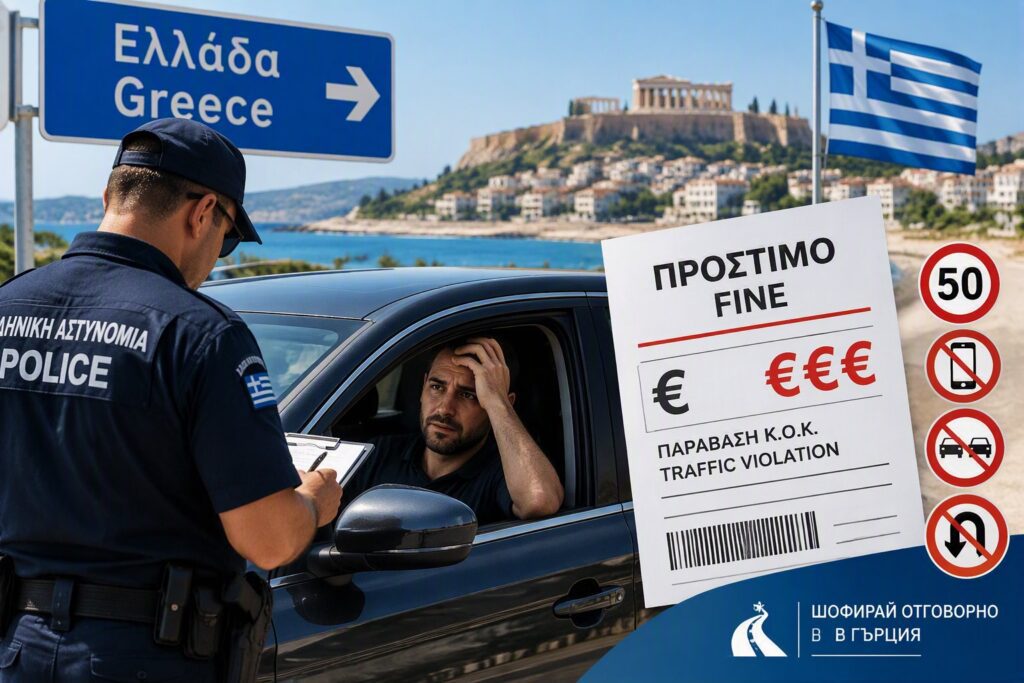
Greece is probably the most popular road-trip destination for Bulgarians. Thessaloniki, Halkidiki or Kavala are all a short drive away, the motorways are good, and the sea is waiting. Over the past year, though, Greece’s traffic code has changed significantly, and the fines are no longer symbolic. One distracted moment with your phone in hand can cost you €350 and a month without your licence.
Here’s what you need to know before you cross the border.
Greece’s New Traffic Code in Brief
The new Highway Code was adopted under Law 5209/2025 and has been in force since 13 September 2025. The idea is simple: higher fines, stricter penalties for repeat offences, and far more cameras. Violations are now recorded electronically, and in Athens and other major cities, speed cameras, red-light cameras and phone-use cameras are already in operation.
One more thing worth knowing: repeat offences now stack up. If you’re caught a second time for the same violation, both the fine and the licence suspension increase sharply.
Speed Limits
The main limits for passenger cars are:
- in built-up areas: 50 km/h, dropping to 30 km/h on an increasing number of narrow streets and near schools;
- outside built-up areas: 90 km/h;
- on expressways: usually 110–120 km/h, depending on the signs;
- on motorways: 130 km/h.
Always watch the signage — in roadwork zones, on bends, or near villages, the limit is often lower than the general rule.
The Fines That Hurt Most
Here are the main violations and the penalties for a first offence:
- Holding your phone while driving: €350 and a 30-day licence suspension. A second offence means €1,000 and 180 days; a third means €2,000 and a full year without a licence.
- Running a red light: €700 and a 60-day licence suspension.
- Failing to stop at a stop sign: €350 and 30 days. If it results in a collision, the penalty is doubled.
- Not wearing a seatbelt: €350 and 30 days for the driver. A passenger without a seatbelt is fined €150.
- Speeding by more than 50 km/h: €700 and a 60-day suspension. Smaller violations start at around €100–150 and rise with the amount over the limit.
- Over 200 km/h or street racing: €2,000 and a one-year suspension. A repeat offence can reach €8,000.
- Parking in a disabled space: €150, a 60-day suspension, and the car gets towed.
Phones deserve special mention. You’re not allowed to hold one even while waiting at a red light. Navigation is fine, but only with the phone mounted on a holder — for calls, use hands-free or Bluetooth.
Drink-Driving
The legal limit in Greece is 0.5 g/l of blood alcohol. For drivers who have held a licence for less than two years, professional drivers, and motorcyclists, the limit is much lower — 0.2 g/l. In practice, even a single beer can be enough to put you over it.
- 0.5–0.8 g/l: €350 and a 30-day suspension;
- 0.8–1.1 g/l: €700 and a 90-day suspension;
- over 1.1 g/l: €1,200, a 180-day suspension, and criminal prosecution.
If you’ve had wine with dinner at a taverna, it’s best to leave the car and take a taxi. Checkpoints along coastal roads in the evening are common.
What You Need to Carry in the Car
Besides your documents, Greek rules require the following equipment in the car:
- a valid driving licence and ID card or passport;
- the car’s registration certificate;
- valid third-party liability insurance, which covers Greece as an EU member state;
- a reflective warning triangle;
- a fire extinguisher;
- a first-aid kit.
The first-aid kit is about to change. From 1 January 2027, it will need to meet the DIN 13164:2022 standard, and not having one will carry a €30 fine. Details: Greece’s new car first-aid kit rules.
Children in the Car
Children shorter than 135 cm must travel in a child seat appropriate to their height and weight. If you place a rear-facing infant seat in the front, you must disable the passenger airbag. The rules are the same as in Bulgaria, but Greek police check them seriously, especially in summer.
Motorways and Tolls
Greece has no vignette system. Instead, motorways have toll stations where you pay according to the stretch you’ve driven. You can pay in cash or by card. Amounts vary by section, so it’s worth budgeting a bit extra if you’re driving further than Northern Greece.
Parking
In town centres, parking is almost always paid. Blue markings usually mean a paid zone, while yellow means no parking at all. Don’t park on pavements, in front of garages, or at bus stops — besides the fine, you risk having your car towed, which is expensive and eats up a lot of time.
Can a Fine Follow You Back to Bulgaria?
Yes. EU member states exchange data on traffic offences, so a violation caught on camera can still be sent to your home address. The idea that a Bulgarian licence plate makes you “invisible” to Greek police hasn’t been true for a long time.
A Few Practical Tips
- Save the emergency number 112. It works throughout Greece, and operators speak English too.
- Watch out for scooters and motorbikes in resort towns — they often overtake on the right and appear suddenly.
- On mountain roads and on the islands, roads are often narrow and without guardrails. Don’t rush.
- If the police stop you, stay calm and polite, and keep your documents within easy reach.
Frequently Asked Questions
Is a Bulgarian driving licence valid in Greece?
Yes. A licence issued in an EU country is valid in Greece without any extra paperwork.
Do I need a green card for Greece?
No. Bulgarian third-party liability insurance covers the whole EU, including Greece.
What’s the fine for holding a phone while driving?
€350 and a 30-day licence suspension for a first offence.
What’s the blood alcohol limit in Greece?
0.5 g/l for most drivers, and 0.2 g/l for new drivers, professional drivers, and motorcyclists.
In Short
Driving in Greece isn’t any harder than driving at home, but the rules are now enforced much more strictly, and the fines are serious. Stick to the limits, keep your phone on its mount, don’t drink if you’re driving, and check your car’s equipment before you set off. That way your holiday starts with sea and sun, not a fine.
This article is for informational purposes and reflects the rules at the time of publication. Fine amounts and requirements may change, so it’s worth checking the latest information before you travel.