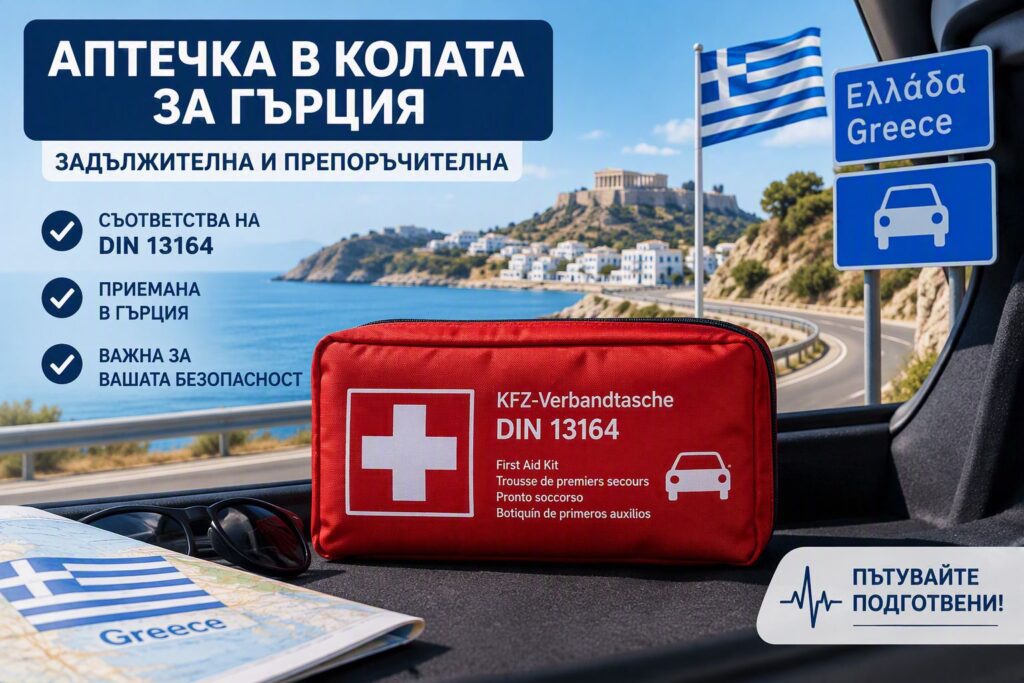
If you’re planning to drive to Greece – wherever you’re setting off from – it’s worth knowing that the car first-aid kit is about to change significantly. From 1 January 2027 a new requirement for the contents of the kit comes into force, and it is far more detailed and stricter than the current one. The old idea of “a little box of plasters in the glovebox” will no longer be enough – the new rules set out exactly what must be inside, in what quantities and to what packaging standards.
When it comes into force and why the date changed
The new requirements apply from 1 January 2027. Interestingly, the rule was originally expected to take effect much earlier, but a parliamentary amendment pushed the date back to the start of 2027 – probably to give drivers and sellers of medical devices more time to prepare.
The legal basis
The change is introduced by a ministerial decision that has already been published. According to some reports the decision is numbered Δ30/45652/2026, but since not all sources confirm the exact number, we recommend checking it directly in the Greek Government Gazette (ΦΕΚ) before relying on a specific number. What is undisputed across all sources is that the new kit must meet the European standard DIN 13164:2022 (or an equivalent ISO standard), and that the fine for non-compliance is imposed under the Greek Highway Code (KOK).
Who it affects and who is exempt
The requirement applies to all motor vehicles travelling on Greek roads. The only exemption mentioned in every source we checked is two-wheelers – motorcycles and mopeds. For all other vehicles, the owner or driver is responsible for having the kit and keeping it in order.
What exactly the new kit must contain
The new kit includes 16 types of items, each of which must carry a CE marking, and the kit’s packaging itself must be labelled with the DIN 13164:2022 standard. Here is the most detailed list we were able to put together from several independent sources:
- An insulating rescue blanket (thermal blanket), metallised, at least 210 x 160 cm, reflecting more than 90% of heat radiation
- A roll of adhesive tape (micropore), 5 m x 2.5 cm
- A set of 14 plasters in different sizes
- Sterile individual dressing, small (about 6 x 8 cm) – 1 piece
- Sterile individual dressing, medium (about 8 x 10 cm) – 2 pieces
- Sterile individual dressing, large (about 10 x 12 cm) – 1 piece
- A sterile burn dressing/compress, 60 x 80 cm
- Six wound compresses, 10 x 10 cm
- Elastic bandage, narrow (6 cm x 4 m) – 2 pieces
- Elastic bandage, wide (8 cm x 4 m) – 3 pieces
- A triangular bandage (for immobilisation)
- Atraumatic first-aid scissors (for cutting clothing and dressings)
- Four pairs of disposable medical gloves (vinyl or nitrile)
- Two wet wipes for cleaning unbroken skin (not wounds)
- Two medical masks, type IIR or FFP2
- Illustrated first-aid instructions, which must be in Greek
It’s worth noting that the new kit contains no medicines. Passengers’ personal medication should not be kept in the car permanently, but separately from the kit.
Packaging requirements
Besides the contents, the new rules also set out what the kit’s packaging must be like. It has to withstand conditions inside a car (including changes in temperature) and protect the contents from dust, moisture and oil. The individual items inside must carry a CE marking in line with the EU Medical Device Regulation (MDR, Regulation (EU) 2017/745), and the instructions and product labels must be in Greek.
Where and how the kit should be kept
The new kit must be easy to reach – not buried under luggage – and must not be locked. No other items, such as tools, should be kept inside the kit. It’s best kept away from direct heat – for example in the glovebox or under a seat – and the contents should be checked every two years, as summer heat speeds up the deterioration of the materials.
The fine at a roadside check
If a traffic police check finds that there is no first-aid kit in the car, or that it does not meet the requirements, an administrative fine of €30 is imposed. That’s not the only thing to think about before driving to Greece – see also our article on vignettes and road tolls to Kavala, and what to do if your licence plates are removed in Kavala.
Should you throw away your old kit straight away?
Not necessarily. According to Manolis Katsarakis, general secretary of the Panhellenic Pharmaceutical Association, existing kits do not automatically have to be replaced before 1 January 2027. The advice is for drivers to check the contents, quantities, expiry dates and any damage to their current kit. Kits whose products have a shelf life of around four to five years are preferable, and the sterility of the items is usually valid for about five years. It’s best to buy kits from a pharmacy or a specialist medical supplies shop, as not every retailer holds the licence needed to sell such products (see also our list of pharmacies and medical help in Kavala in case you need one locally). And if you’re travelling in a rental car, have a look at our article on car rental in Kavala and check whether the rental company already provides such a kit.
Frequently Asked Questions
When does the new kit become mandatory?
From 1 January 2027.
Which vehicles does the change affect?
All motor vehicles in Greece, except motorcycles and mopeds.
What is the fine if the kit is missing or doesn’t meet the requirements?
An administrative fine of €30 at a traffic police check.
Does the kit have to contain medicines?
No. The standard kit does not include medication – that is carried separately, at your own discretion.
Do I need to buy a new kit right now?
Not necessarily straight away. It’s more important to check the contents, quantities and expiry dates of your current kit before deciding whether to buy a new one.
In conclusion
The new rules for car first-aid kits come into force on 1 January 2027 and raise the bar considerably compared with the old, much simpler requirements. Besides the exact list of 16 types of items, it also matters how the kit is packaged and where it is kept. The €30 fine isn’t large in itself, but it’s a good reason to check in good time exactly what you have in your car’s glovebox.